Calling on the Scottish Government to create 100-year plan for tree planting and a radical greening of our places
March 18th 2026
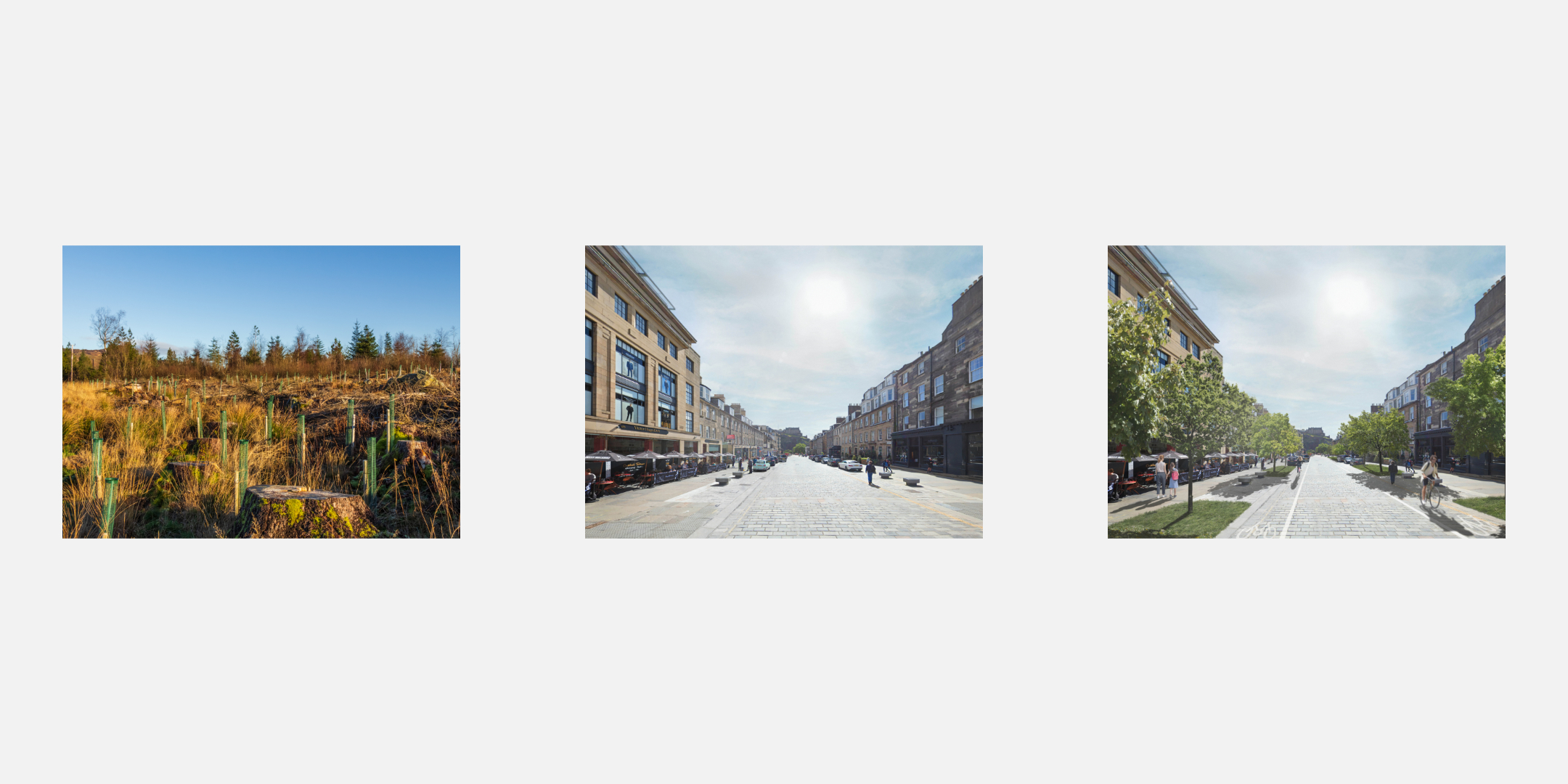
Trees are a vital component of the places we live. Our past relationship with them has been exploitative, we need to move to a symbiotic approach.
Following World War 1, the crisis in lack of available timber and its impact on the war effort triggered The Forestry Act of 1919. Forestry in Scotland had dwindled to around 5% tree canopy cover. The Act was created to urgently address this scarcity, and so vast monocultures of fast-growing Sitka Spruce were planted across Scotland.
Today, tree canopy cover is around 19% of the total land area in Scotland. While this moves us away from immediate peril, it is not enough. Today, the crisis we face is climate change and once again urgent action is required. New legislation to further expand tree canopy cover, with the same bold vision of 1919, is required.
Anderson Bell Christie (ABC), through their White Paper, Balance, have identified a need to boost tree planting in Scotland. Tree planting has a vital role to play in reducing climate impact. Trees remove carbon from the atmosphere, reducing flood risk, mitigate urban heating, improve air quality, enhance biodiversity and wellbeing. A mass planting programme is needed to mitigate the carbon associated with construction and create more resilient places.
The construction industry is making positive progress to reduce the energy buildings use, however there is a hidden carbon burden. Embodied carbon is an unseen and unregulated area of the construction industry. This is the carbon emissions associated with creating materials and constructing them into buildings.
ABC Community Carbon Consultant, Dr F. P. Ekdi said, “to put this into context new housebuilding in Scotland to 2050 will release around 74 million tonnes of embodied carbon emissions. There is no plan in place to address these emissions.”
ABC’s calculations show that over 107,000 hectares of tree planting would be needed to sequester the embodied carbon of these new homes across their lifetime. This would then need to be multiplied many times to cover all other construction activity in Scotland.
A dual approach is needed, where drastic action is taken to reduce embodied carbon in construction alongside a bold tree planting programme. ABC assert that to achieve this, carbon must be connected to place.
Local Authorities recognise the need to plant trees and have set their own ambitious programmes. These need more support to go further and faster. They need to become a major component of 2045 Local Development Plans and be fully integrated with urban regeneration strategies.
Research from European Environment Agency identified an average of 30% tree canopy cover in European capital cities. By comparison Glasgow currently has 15% and Edinburgh 17% tree canopy cover. This means there is scope to enhance both Glasgow and Edinburgh’s tree-planting programmes and bring the green character of the cities more in line with European counterparts. Scotland should increase it’s aspirations.
This could be achieved by a significant greening of our built environment, using the spaces that already exist between buildings. In doing so the additional investment in these programmes would yield significant benefit by reducing the severity of climate change impacts, such as flooding and overheating. Communities would experience better health outcomes with improved air quality and reduction in environmental stress.
ABC Community Carbon Consultant, Dr F. P. Ekdi said, “we call on the Scottish Government to take a dual approach. First, turbo-charge existing local authority tree planting programmes by significantly increasing funding and adapting local development plans. This could be achieved by shifting funding from mono-culture forestry (that is still facilitated today) to nature-based solutions and urban greening. This is supported by the Royal Society of Edinburgh in their inquiry into public financial support for tree planting and forestry. Second, implement a new policy suite to regulate embodied carbon in the construction industry to drive down emissions from the sector. Our White Paper, Balance, provides roadmaps to illustrate how this could be achieved.”
A carefully considered approach to both aspects will allow 2045 net zero targets to be achieved while making the places we live healthier and more resilient. Over 100 years on from the first Forestry Act, Scotland needs ambitious new plan for the next century.